
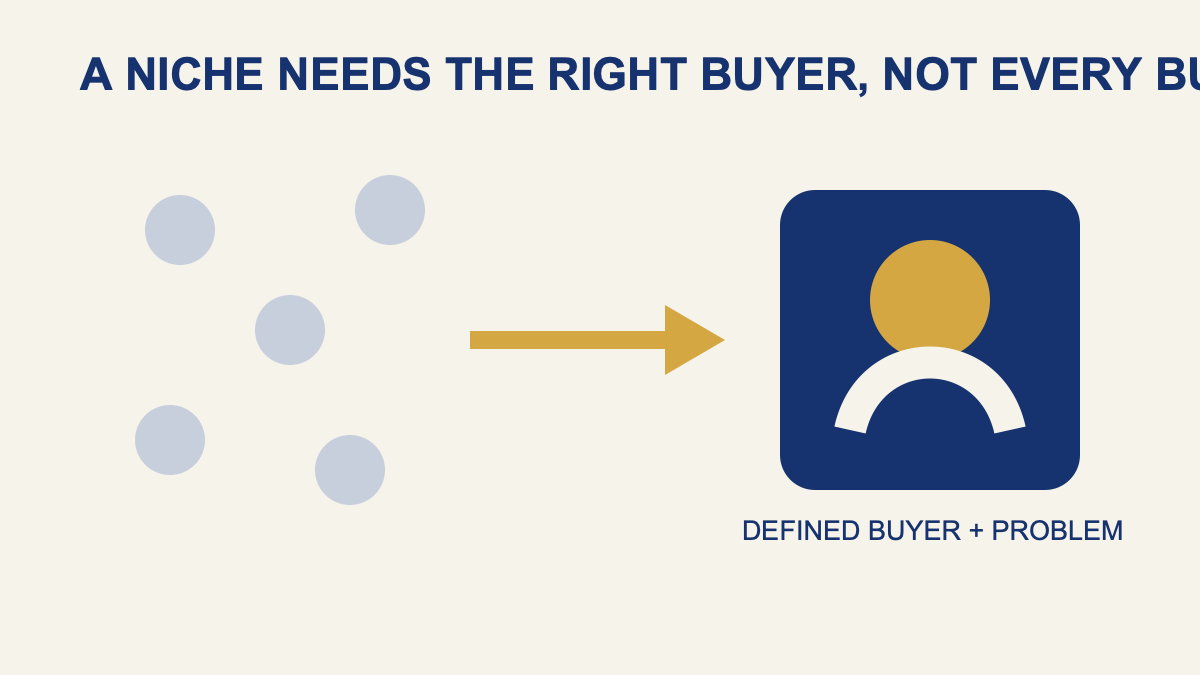
Ten thousand people who enjoy your posts and one hundred people trying to solve an expensive problem are not the same audience.
The first number looks better in a media kit. The second may be closer to a business—if those people can be identified, reached, and served with an offer that solves the problem they actually have.
That does not mean a small audience is secretly more valuable than a large one. It means follower count alone is a weak test for whether an expert should explore a second market. For a niche expert, the first question is not “Can I become known there?” It is “Is there a specific buyer problem that my existing product could responsibly test?”
The audience question can send you to the wrong starting line
Imagine a specialist who teaches a narrow operational method. Their newsletter is modest. Their videos are useful but not viral. At home, their work is bought by a recognizable group: teams facing a regulated process, managers responsible for a costly handoff, or professionals seeking a particular certification.
When that specialist asks about China, the obvious response is often: build an audience first.
Sometimes that is exactly right. If the offer depends on personal fandom, entertainment reach, or daily creator presence, starting with an audience may be unavoidable. But that advice is less complete for expertise tied to a concentrated professional problem. The first evidence may come from buyers and delivery conditions, not from follower growth.
Patreon’s State of Create report emphasizes the value of direct relationships and core fans. It does not show that every niche can travel internationally, nor that a smaller audience guarantees purchasing intent. It is a useful reminder that total reach and relationship depth measure different things.
A niche can be commercially real without being broadly visible
Some problems are naturally narrow: a particular compliance workflow, cross-border team management, technical implementation, or a high-stakes professional decision. They may never produce mass-market content. Yet the cost of getting the decision wrong can be high, and potential buyers may cluster in particular roles, firms, associations, or professional communities.
The key word is may. Niche does not prove demand. It only gives you a clearer way to investigate it.
A second market is not validated by the size of the crowd. It is validated by the clarity of the problem, the buyer, and the path to a usable offer.
This distinction also separates this article from our anonymous field note, A Niche Expert Does Not Need a Mass Audience. They Need the Right Buyer.. That article explains an evaluation pattern. This one is a decision guide for an expert considering whether a new geography is worth a bounded test.
Start with one buyer problem, not a promise to “enter China”
China is not a generic extension of an existing audience. The International Trade Administration’s China market-entry guidance stresses the importance of local conditions, partner diligence, and a market-specific approach. For an expert product, that means the test should be narrower than a market-entry announcement.
A useful first hypothesis has five parts:
- One capability: the expert’s method or subject-matter strength.
- One representative offer: a course module, workshop, template, or training asset that can be assessed without exposing the whole catalogue.
- One buyer group: not “Chinese users,” but a defined role, organization type, or professional community.
- One costly or recurring problem: a problem the buyer can recognize in plain language.
- One controlled access path: a permitted research, partner, channel, or interest-collection route that can produce a signal without pretending demand has already been proven.
The result may be encouraging, inconclusive, or negative. All three are useful. A limited test that finds no reachable buyer or no workable delivery condition can prevent a larger, more expensive mistake.
What still has to be true
A tight buyer hypothesis is not enough on its own. Before using China as the proposed second market, an expert product still needs product evidence, adaptation room, and a safe rights path.
For example, a method may depend on software that target users cannot reliably access, examples that cannot be adapted, or a credential system that does not transfer. The creator may also decide they do not want the material translated, tested, or distributed. Those are not implementation details to solve later; they can be valid stopping conditions.
OriBridge’s role at this stage is not to declare that a niche will sell in China. It is to help a suitable product owner assess the buyer problem, product readiness, delivery constraints, and authorization boundaries before anyone offers, translates, or distributes paid content. A Strong Course, the Wrong First Move shows why course quality alone does not answer the market question.
The decision worth making now
Do not wait for a million followers to ask whether your expertise has a second-market use. But do not mistake professional specificity for demand, either.
The responsible first move is small enough to stop: review one representative asset, define one buyer problem, check the adaptation and rights constraints, and look for a credible path to a signal. If the signal is absent, pause. If it is real, the next conversation can be about scope—not about a guaranteed launch.
Have a mature, specialist offer and a question about China? Submit a product link, outline, or representative material for a China Product Card conversation. OriBridge starts with fit and constraints; any content testing or authorization is discussed only with explicit approval.
Want to test this model in China? Share one public product link and one decision you need to make. Start a China fit review.
Knowledge hub: Continue with the Product Fit & Validation hub for the wider decision path.
Sources
- Patreon, State of Create 2025 (accessed July 30, 2026)
- International Trade Administration, China Market Entry Strategy (accessed July 28, 2026)
- A Niche Expert Does Not Need a Mass Audience. They Need the Right Buyer.
- A Strong Course, the Wrong First Move