
“This agent can turn a China market brief into a summary.”
That sentence appears in many AI-course outlines. It may be a statement about an official feature page, a presenter’s demo, a learner exercise, or a genuine result from someone’s work. Those are not the same kind of evidence. Yet course pages regularly blur them into one smooth claim.
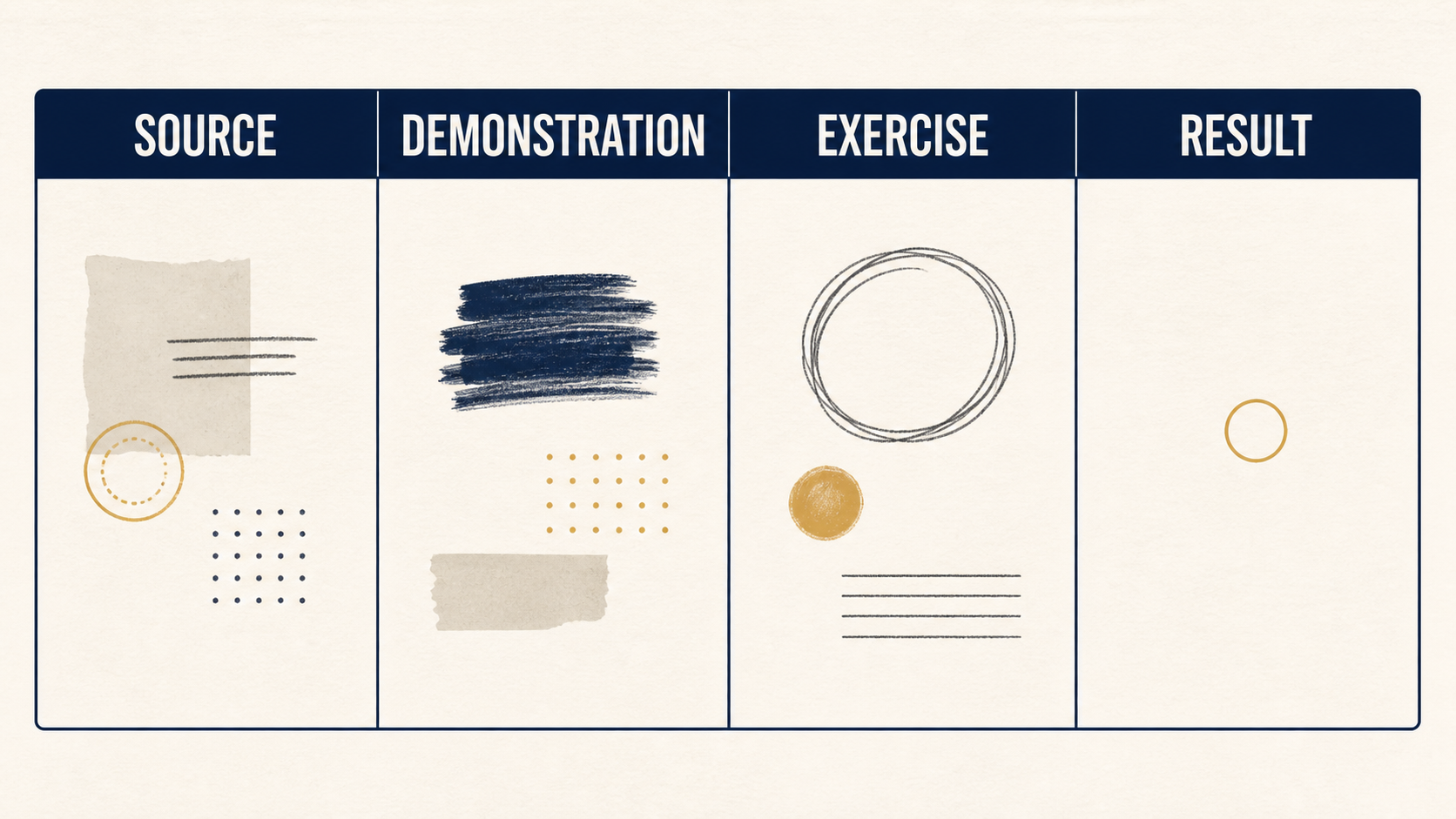
The repair is not a longer disclaimer. It is a small evidence table with four columns: source, demonstration, exercise, result. Put each claim in one column before it reaches a course page, a workshop slide or a sales conversation.
The quick answer
An official tool page can support a narrow claim about a product surface. A controlled demonstration can show that an instructor produced an output under stated conditions. A learner exercise can show that a participant completed a defined task. A result needs its own before-and-after evidence. If a claim has no matching evidence column, label it as unverified rather than letting it borrow credibility from a nearby demo.
This is particularly important in China-facing AI education, where tool names, product interfaces, access conditions and workflows can change quickly. A good evidence table makes the course easier to revise without turning every new feature into a promise.
Four boxes, four different statements
| Evidence box | The narrow question it answers | Example of a defensible statement | It does not answer |
|---|---|---|---|
| Source | What does an official document describe? | “The documentation describes a workflow configuration surface with specified inputs and outputs.” | “The workflow is reliable for every learner.” |
| Demonstration | What happened in a controlled presentation? | “In this recorded demo, the instructor used the stated inputs to produce this draft.” | “Learners can reproduce it in their environment.” |
| Exercise | What did a learner actually attempt or submit? | “Participants completed a source-citation exercise using the stated rubric.” | “Their workplace performance improved.” |
| Result | What changed outside the exercise? | “A defined workflow metric changed over a stated period, subject to attribution limits.” | “The tool caused the change by itself.” |
The table is intentionally conservative. Its purpose is not to make a course sound less capable. Its purpose is to stop it from making a claim it has not earned.
A familiar failure: one sentence, four borrowed meanings
Consider a workshop called “Build a China Research Agent.” The instructor opens a tool, connects a knowledge source and gets a clean answer. The slide says: “The agent saves analysts hours.”
What is actually known?
- The source may establish that a workflow or tool-calling feature exists. Alibaba Cloud’s workflow documentation separates configurable components and their input/output surfaces. Volcengine documentation similarly distinguishes tool calls, knowledge retrieval, connected functions and other tool surfaces.
- The demonstration may establish that the instructor obtained an answer in that exact setup.
- The exercise might establish that a learner can document sources and flag uncertainty in a trial task.
- A claimed time saving, however, is a result. It needs a baseline, an observed change, a defined role, a time period and a credible explanation of what else changed.
The first three pieces do not magically fill the fourth box.
Use the empty cell as a design signal
Teams often see an empty “result” cell as a weakness. It can be a useful design signal instead.
If a course only has source evidence, it may be an orientation. Do not sell it as a capability programme yet.
If it has a good demonstration but no learner exercise, it may be a convincing presentation rather than a teachable method. Add a task with a visible output and a review rule.
If it has exercises but no result evidence, it may still be a useful workshop. Describe the workshop honestly: participants practise a method and create an inspectable artifact. Do not promise business improvement.
This gives an expert a more precise next move than “add more AI content.” It identifies the missing layer.
A working example: research summaries
Suppose the course teaches analysts to create a China market research summary from supplied documents.
Source
The instructor records which product documentation was consulted and which inputs the workflow accepts. This is where official documentation belongs. It is not an endorsement of the course, and it is not a claim that every account has the same conditions.
Demonstration
The instructor runs a disclosed sample pack. The resulting summary is shown beside its cited source passages and a list of open questions. A useful demo includes failure: perhaps the answer misses a qualification condition, so the instructor shows how the reviewer catches it.
Exercise
The learner receives a different source pack. Their task is not merely to generate a fluent paragraph. It is to label which sentence comes from a source, which is an inference, and which needs a buyer interview. The artifact can be reviewed without claiming that it predicts a market.
Result
Only later, and only with permissioned records, could a team study whether this method changed the speed or quality of a real research process. Even then, the report must name the metric and alternatives; it cannot credit the model alone.
This is a much more credible course story than “AI does market research.”
Why course authors need this before localization
When a course is adapted for China, teams can accidentally translate a claim more strongly than the underlying evidence supports. A phrase such as “proven workflow” can become a product promise. A screenshot can become apparent proof that an account path is universally available. A polished result can hide the fact that the presenter selected the input and corrected the output.
The evidence table keeps the claim attached to the thing that supports it. It also tells a local editor what not to embellish.
This complements an AI-agent workshop evaluation rather than replacing it. Evaluation asks how a workshop activity should be assessed. The table asks a prior question: what kind of proof is each sentence trying to use?
Build the table before writing the landing page
For every headline claim, create one row:
| Claim draft | Source | Demo | Exercise | Result | Public wording now |
|---|---|---|---|---|---|
| “Use a workflow to create a sourced research outline.” | Official configuration page | Instructor sample | Learner submitted outline | Blank | “Practise creating a sourced outline.” |
| “Reduce research turnaround.” | Blank | Blank | Blank | Blank | Remove or label as a hypothesis. |
| “Learn to review uncertain answers.” | Course rubric | Instructor correction example | Learner review note | Blank | “Practise a review method; no workplace outcome is claimed.” |
Writing the public wording last is important. It prevents marketing language from deciding what the evidence ought to be.
What the official pages do—and do not—give you
Official documentation can be excellent evidence for interface distinctions. The Alibaba Cloud and Volcengine pages are useful because they show that workflow components, retrieval and tool calls are not a single undifferentiated capability. That helps an instructor define the lesson.
They do not demonstrate quality, account access, learner success, legal fit, buyer appetite or return on investment. China Government Procurement Network guidance can show that objectives, audiences, content and assessment may be specified separately. It does not make a public purchasing model into the right structure for every private workshop.
The narrow reading is not timid. It is what lets a course stay accurate as the surrounding tools change.
When not to use this table
An article that simply documents an API field may need a source citation but not a learner-outcome column. Conversely, a confidential internal programme may use a richer evaluation system than a public course page can show.
The table is most useful when a team is making claims about what an AI course, workshop or localised method will enable people to do. It is not a substitute for research consent, rights clearance or an actual outcome study.
Two adjacent controls answer different questions. The China training procurement brief guide helps separate a requested service scope from the course object itself. When Topic Popularity Is Not Buyer Demand keeps a visible subject from being promoted into a buyer claim. Use those controls before filling the result column.
Sources
- Alibaba Cloud Model Studio workflow application documentation
- Volcengine Ark tool-calling documentation
- China Government Procurement Network guidance on procurement needs
A bounded next step
If you are deciding whether an existing AI lesson is ready for a China-facing test, request a private validation review. Start with one claim and its empty evidence cells, rather than beginning with a promise the course cannot yet support.