
An overseas instructor is invited to run a small China-facing training pilot. A single contact says, “Our team would like to try it.” The instructor sends a link, the contact opens it, and everyone calls the pilot started.
Then the familiar gaps appear. The contact cannot approve a paid continuation. Someone else has to configure the learning space. The people who need the training were not in the first conversation. A manager wants evidence of changed work, while the instructor has only a list of people who opened the page.
The problem is not that any person failed. The pilot was treated as if “the customer” were one role.
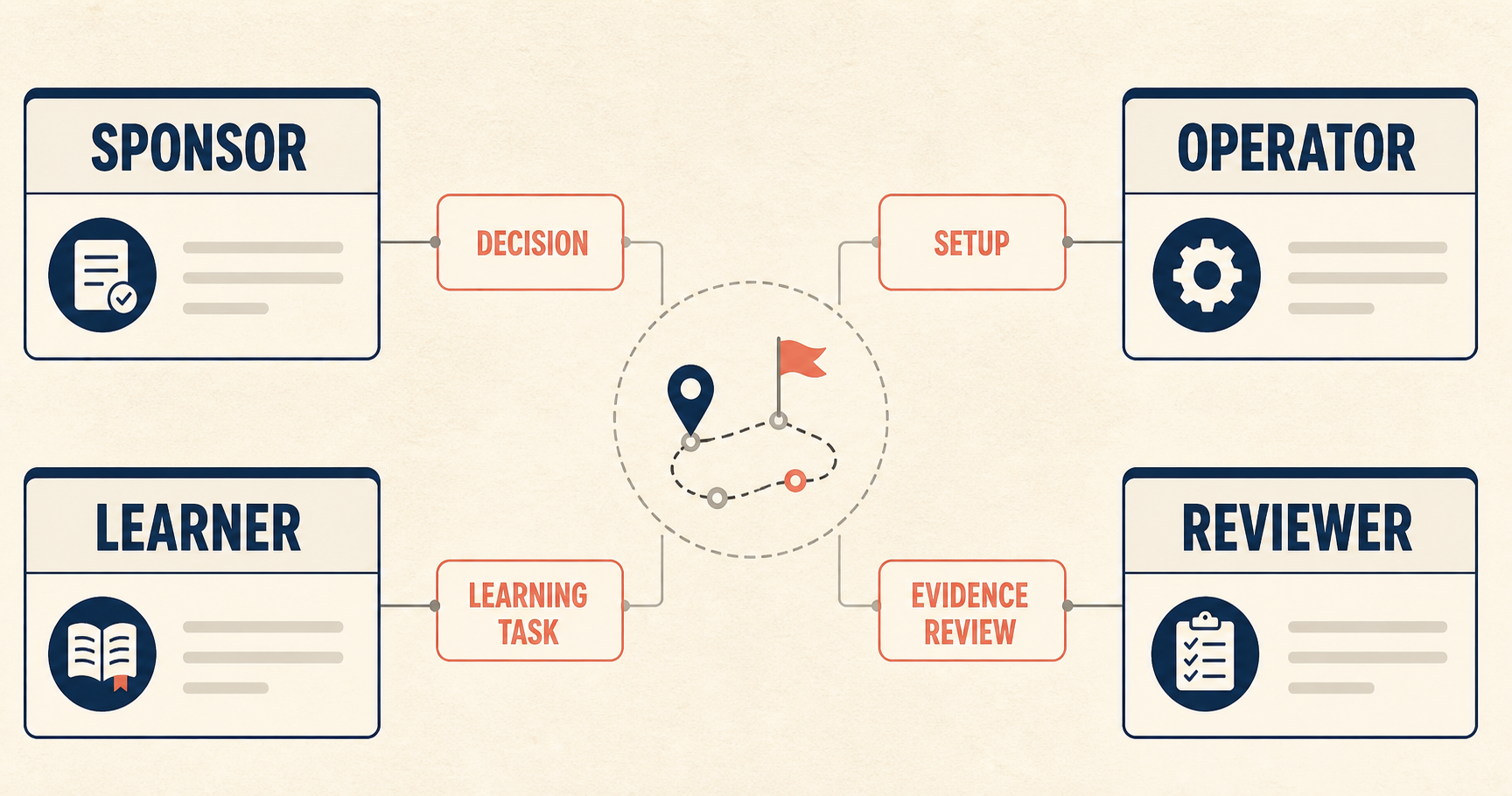
Before testing a China-facing course, draw four roles: sponsor, operator, learner and reviewer. One person may occupy two or even all four roles in a small trial. The point is not to create bureaucracy. It is to make the overlap explicit, so a successful conversation or login is not mistaken for a working learning and decision path.
The four-role map in one minute
Use this map before you select a platform, promise a report or call a pilot successful.
| Role | The question this person answers | Typical evidence | What this role does not automatically prove |
|---|---|---|---|
| Sponsor | Should this pilot happen, and what decision follows it? | A bounded purpose, budget or approval condition | That the course is configured or anyone learned |
| Operator | Can the agreed path be set up and supported? | Setup record, access check, support route | That the content fits the learner’s job |
| Learner | Can the intended person complete the learning task? | Exercise, question, completion evidence | That management accepts the result |
| Reviewer | What evidence is enough to judge the pilot? | Pre-agreed review question and record | That a pilot deserves continuation |
The roles are named by job, not title. “HR,” “marketing,” “IT,” “founder” and “partner” may each hold one, but a title alone does not identify the decision owner.
Why a single contact creates false confidence
Suppose an HR manager asks about an AI workflow course. The HR manager may be the sponsor: they can state why the organisation is considering training and what decision a pilot should inform. But an operations colleague may need to set up invitations and support. The intended learners may be analysts who were not on the call. A business lead may be the reviewer who decides whether the practice exercise was relevant.
If the instructor only tests whether HR can open a landing page, the test has answered a narrow access question. It has not tested operational handoff, learner performance or whether the reviewer finds the record useful.
This is not China-only. In a cross-border pilot, language, support, delivery and evidence often cross several people and systems. Treating the first contact as the organisation hides those handoffs.
Read public materials as role clues, not market proof
Official materials can help reveal why roles should be separated, provided they are read narrowly.
Xiaoe-Tech’s merchant guidance presents content, users, messages or feedback, orders and channels as different management surfaces. Bilibili Classroom’s course-content guidance distinguishes learning objectives, audience, syllabus consistency, video/subtitles and validity period. These pages do not establish access, demand or a private buyer’s decision process; they simply show why “the course” is not one undifferentiated object.
Public training documents can be read in the same careful way. One National Open University project lists delivery, platform support, communication, attendance and a report; a Xiamen project distinguishes interview, diagnosis, process verification and acceptance. They are not private-market evidence, but they make separate delivery, operation and review work visible.
The map below therefore does not prescribe an organisation chart. It gives a pilot team a way to ask, “Who owns this decision in our situation?”
Role 1: sponsor—name the decision, not just the interest
The sponsor is accountable for the reason the pilot exists. That may be a team lead, a product owner, a buyer, or an individual creator testing their own product. Their job is to state the bounded decision at the end of the pilot.
Good sponsor questions sound like this:
- “Should we invest in adapting this one workshop for this audience?”
- “Does this learning task appear relevant enough to justify a larger evaluation?”
- “What would make us stop rather than extend the pilot?”
Weak sponsor language is “Let’s see what happens.” Curiosity is useful, but it is not a review condition. Without a decision, the team cannot tell whether a login, a learner question or a short report matters.
Do not assume the sponsor has technical setup responsibility. A sponsor can approve a narrow trial while asking another person to operate it.
Role 2: operator—own the path, including failure handling
The operator makes the intended path practical. They may configure the course page, manage invitations, prepare a support response, confirm the version of the material, or record a blocked step. They do not need to be an engineer; they need to own the path when a learner cannot proceed.
An operator checklist is short:
- What is the exact entry point for the pilot?
- Which course version and materials are being used?
- Where does a learner report a problem?
- Which failures are logged, and who sees them?
- What is the fallback if one step cannot be completed?
The end-to-end access, payment and delivery test script is useful here because it separates an access path from broader commercial conclusions. The operator’s success is not “nothing went wrong”; it is that a known failure has an owner and a record.
Role 3: learner—define the work they should be able to do
The learner is not just a registered user. The role needs a real task: identify a risk in a workflow, compare two options, prepare a short output, or practise an agreed method. A video view alone is weak evidence that the course met its purpose.
This does not mean every pilot needs an exam. The team should know the learner’s intended attempt, available inputs and a sensible partial completion.
For example, a one-hour AI workflow session might ask learners to mark where a source needs checking before a generated summary is used. A worksheet plus a failure note says more than attendance.
If the learning task cannot be named in one sentence, the pilot is probably testing a presentation rather than a learning object.
Role 4: reviewer—decide what counts as enough evidence
The reviewer protects the pilot from a vague ending. This person may be the sponsor, a subject-matter lead, a manager, or an agreed peer reviewer. Before the pilot starts, they should state what evidence will be reviewed and what it can support.
The reviewer might ask:
- Did the intended learner understand the defined task without a hidden workaround?
- Did the course version, support route and recorded issue make the test interpretable?
- Is the result enough to revise the material, run a second test, or stop?
The reviewer should not be asked to prove sales, job performance or market demand from a tiny pilot. A China test plan with stop conditions helps keep that boundary explicit.
A constructed pilot map
Consider a small company evaluating a China-facing AI-workflow workshop for eight analysts.
- The sponsor is the operations director. Their decision is whether to fund a larger internal trial if the task is understandable and the delivery record is complete.
- The operator is a programme coordinator. They prepare invitations, make the current module available, and log access or support issues.
- The learners are eight analysts. Their task is to evaluate a workflow example against a supplied source-and-output checklist.
- The reviewer is the director plus a subject-matter lead. They review the completed checklists and failure notes, not merely attendance.
What would not count as success? The coordinator opening the page; all eight names appearing on a list; or a manager saying the topic sounds useful. Each fact answers a different question. The map prevents them being piled into a false conclusion.
This is a constructed example. It does not report an OriBridge client, an actual organisation, a platform capability or a commercial outcome.
When roles can legitimately collapse
A solo expert testing a private lesson for themselves can be sponsor, operator, learner and reviewer. A single buyer in a one-person business may also hold all four roles. In that situation, write the four headings anyway. The exercise will expose which assumption is being self-approved.
For instance, the person may be able to access the material but still have no independent reviewer of whether the task is useful. That is not fatal; it simply changes what the pilot can claim. Call it a usability check, not evidence of broader fit.
Conversely, do not force a four-person committee onto a simple personal test. The map is a clarity device, not a service requirement.
The handoff that should happen before launch
Before the first invite, each role should complete one sentence:
- Sponsor: “At the end, I need enough evidence to decide ______.”
- Operator: “If the intended path breaks, I will record and route it through ______.”
- Learner: “I am expected to complete or attempt ______.”
- Reviewer: “I will review __, and it cannot by itself prove ____.”
If any line stays blank, postpone the launch long enough to fill it. That small delay is cheaper than discovering that nobody owned the question the pilot was supposed to answer.
For a broader view of the commercial problem before a pilot, use the buyer–problem–alternative–delivery worksheet. If a public training brief appears to ask for far more than a course, read when a China training brief buys a service, not just your course.
The sentence worth keeping: a pilot does not have one customer; it has four jobs that may be held by one person or several.
If you need to map a bounded first test without claiming that a link or an attendance list proves demand, request a China validation review.
Sources and evidence boundary
- Xiaoe-Tech merchant instructions, checked 2026-08-24. It presents separate management surfaces for content, users, feedback, orders and channels; it does not prove access, demand or outcomes.
- Bilibili Classroom course-content guidance, checked 2026-08-24. It distinguishes course fields such as objectives, audience, syllabus, subtitles and validity period; it does not define a pilot model.
- National Open University teacher-training support procurement intention, checked 2026-08-24. It lists delivery, platform support, communication, attendance and a report for one stated public project; it is not evidence of private-market demand or eligibility.
- Xiamen SME digital-transformation project notice, checked 2026-08-24. It distinguishes several project phases; it does not prescribe a commercial training pilot.