
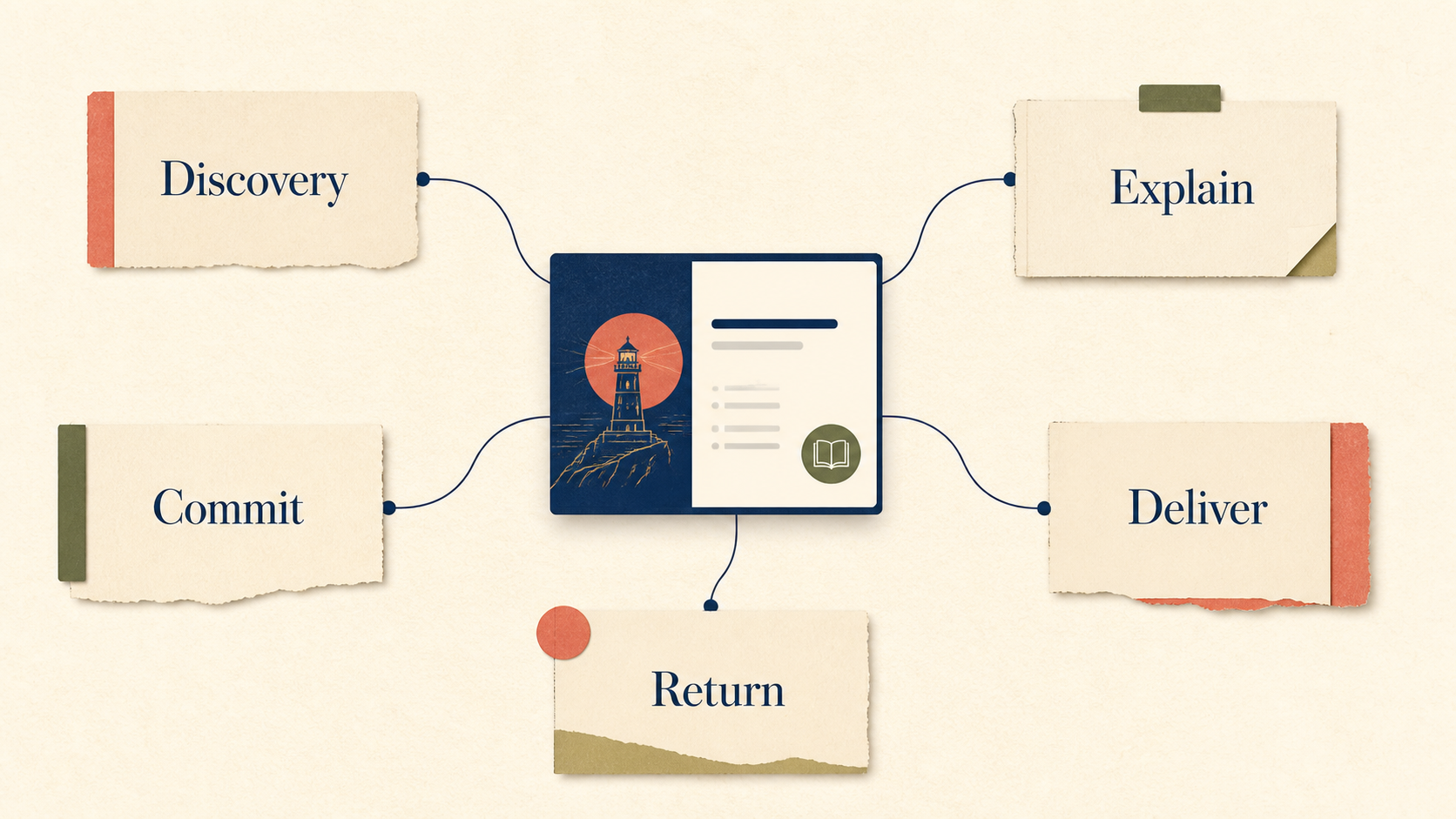
An English course team has a useful ten-minute lesson clip. Someone suggests posting it everywhere: a public answer, a short video, a course page, a community update and a launch notice. By Friday, the same clip has five captions and no agreed purpose.
That is not distribution. It is duplication.
For a China-facing knowledge product, begin with a smaller decision: what job does this asset have here? One asset can be adapted into several pieces, but each piece should normally carry one primary job: discovery, explanation, commitment, paid delivery, or retention. The point is not to copy a Western funnel. It is to stop a team from treating every visible surface as interchangeable.
The map in one minute
Think of a course as a small town, not a single shopfront. People need different signs at different moments.
| Job | What the reader needs | Useful asset form | What it must not pretend to do |
|---|---|---|---|
| Discovery | “Why should I notice this?” | a short problem-led clip or public answer | teach the full course |
| Explanation | “What is this actually about?” | an outline, sample framework or annotated example | promise access or support |
| Commitment | “What exactly am I buying?” | a course card, FAQ and scope statement | hide unconfirmed benefits |
| Delivery | “Where is the learning material?” | controlled module, link and learner instruction | generate public discovery by itself |
| Retention | “What changes next?” | reminder, update note or community prompt | replace a lesson or support process |
The useful test is blunt: if someone removes this asset, which job becomes harder? If the answer is “all of them,” the asset has not been assigned a job yet.
A constructed example: one clip, four decisions
Imagine a course on using AI to turn a public competitor page into a comparison table. The team has a ten-minute English demonstration.
For discovery, the visible piece may ask a narrow question: Can you tell whether an AI comparison is traceable before you trust it? It shows the tension, not the lesson.
For explanation, a short page can show the three-column output—source, observation, uncertainty—so a prospective learner understands the method.
For commitment, the course card must say what is included, what the learner needs, and what is not promised. It should not recycle a curiosity-driven clip as if it were a delivery description.
For delivery, the actual module needs instructions, source material, an exercise and a way to tell whether the learner completed the task. That is a different object again. An end-to-end access, payment and delivery test is useful precisely because a good public post cannot prove that this path works.
Finally, retention may be a short notice that the exercise source pack changed. It is not a new lesson, and it is not a claim that a tool is available to every learner.
Before any of those assets moves into production, a localization readiness checklist can expose missing source files, terminology decisions and delivery assumptions. The surface map assigns the job; readiness review checks whether the team can responsibly perform it.
This example is constructed. It does not report an OriBridge customer result or a platform capability.
Why platform pages are only a clue
Official pages from Xiaoe Tech, Bilibili Cheese and Zhihu describe separate surfaces for content, membership or purchase settings, promotion, and ongoing operation. That separation is the useful observation. It does not establish whether a foreign team can open an account, accept payment, obtain traffic, or sell a particular course on any one service.
The surface map therefore comes before platform selection. First decide the job. Then test whether a proposed surface can carry that job without creating a false promise.
A practical whiteboard exercise
List each asset you have: video segment, newsletter issue, worksheet, founder explanation, course outline, update note. For every row, write only one job and one next action.
If an asset is marked both “discovery” and “delivery,” split it. If the course page has no commitment owner, stop polishing the copy and find the person who can verify its statements. If a community reminder is being used to explain a complex method, make a proper explanatory asset instead.
This also clarifies why a question-led Zhihu content probe differs from a paid learning promise. One can make a problem legible; neither should silently inherit the delivery promises of the other.
When not to use this map
Do not turn a simple internal notice into an ecosystem exercise. If a team is notifying existing, named customers about one scheduled call, a direct message with a confirmed owner is enough. The map is for a product with multiple public and learner-facing surfaces that risk being confused.
It cannot prove demand, conversion, rights, platform access or payment eligibility. It only exposes an earlier problem: whether the team knows what every asset is supposed to accomplish.
Run the map as a decision meeting, not a content brainstorm
The map works best in a forty-minute working session with the person responsible for course content and the person responsible for learner operations. Put the current assets in the first column. Do not start by asking which channel is fashionable. Ask three questions in order.
First, what moment in the reader’s decision is this asset for? A short clip may help somebody recognize a familiar problem. It usually cannot explain all prerequisites. A course outline can explain scope, but it cannot prove that delivery is ready. A learner reminder can reduce uncertainty after purchase, but it should not become the only place where a material course change is described.
Second, what evidence lets the team make this asset? For a commitment asset, that may be the approved outline, delivery condition and named support route. For an explanatory asset, it may be an annotated public example. If the necessary evidence is unavailable, label the proposed asset “hold” rather than drafting around the missing fact.
Third, what would be a bad substitute? This question catches most overlap. A public answer is a poor substitute for a controlled lesson. A course-card promise is a poor substitute for an access test. A polished discovery post is a poor substitute for a plan to answer learner questions.
A compact working sheet
Use one row per proposed asset:
| Asset | Primary reader moment | One job | Evidence required | Owner | Bad substitute |
|---|---|---|---|---|---|
| 45-second clip | first recognition | discovery | approved problem statement | editor | full lesson |
| annotated example | comparison | explanation | source pack | course lead | sales promise |
| course card | before purchase | commitment | confirmed scope | product owner | access test |
| module instruction | after entry | delivery | current lesson version | facilitator | public teaser |
| change notice | after an update | retention | version record | operations | new curriculum |
The sheet is intentionally unspectacular. Its value is that it creates a place to say “we do not yet know.” Teams that skip that sentence tend to hide uncertainty in more content.
What to review after the map is drawn
Read the map from the learner’s point of view. Can someone move from discovering the problem to understanding the offer without being asked to infer hidden terms? Does the commitment page send them into a delivery path that has actually been tested? Does the retained learner receive an update through a route that has an owner?
If the answer is no, do not add another channel. Repair the missing job. This is also why the map should be revisited after a change in the offer, course version or delivery route. It is a coordination device, not a one-off diagram for a launch deck.
The map does not prescribe a universal funnel, and it does not decide where a team should operate. It helps the team ask a prior question: what must this particular asset accomplish before a platform choice can be evaluated?
Keep the map dated. A new course version, a different support arrangement, or a changed learner route can move an asset into a different job. The diagram is useful only while it reflects the current offer rather than a launch-time memory.
Related controls: use the Zhihu question-led content probe for an explanation surface, the end-to-end test script for an operating route, and the localization readiness checklist before treating an asset as ready to adapt.
Before choosing more channels, request a China market validation review to test one job, one audience and one evidence path.