
The content calendar looked reassuring: thirty topics, six audience segments, and enough headlines to fill a month.
Then someone asked a more useful question: What is the Chinese reader already trying to understand?
For an overseas expert testing a China-facing idea, that is not a philosophical distinction. It changes the first experiment. A Zhihu answer can test whether one explanation lands with readers who have already phrased a problem. It cannot tell you that those readers are buyers, that your account is eligible, or that a course will sell.
The useful sentence is simple:
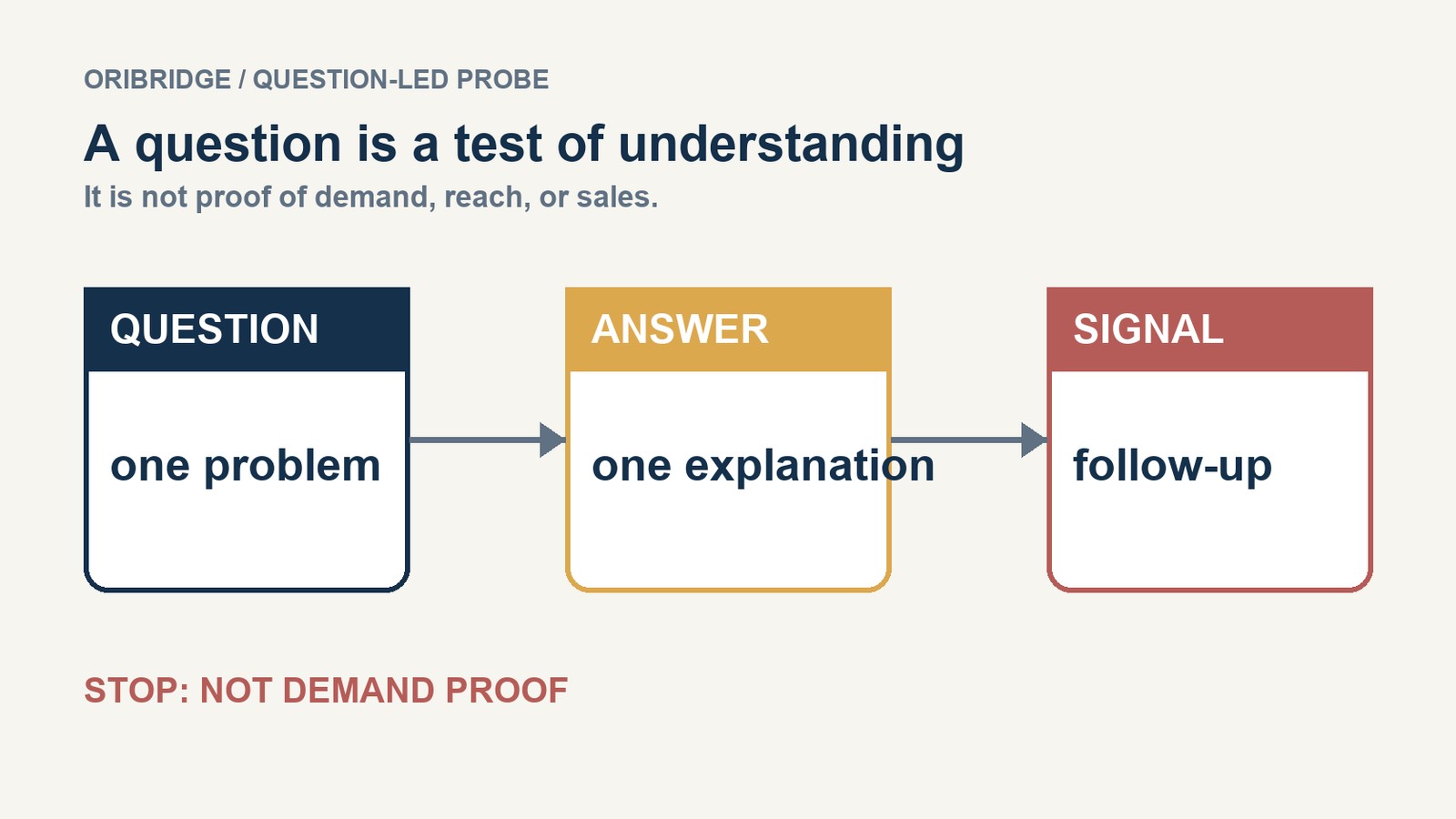
A question can test whether your explanation lands; it cannot test whether your course sells.
The first test is about understanding, not demand
Imagine an expert who teaches workflow automation. The English version begins with a familiar promise: “Save five hours a week by automating repetitive work.” A Chinese reader asks a narrower question: “How do I automate this if my team cannot use the same overseas tools?”
That question gives the expert a real object to work on. The expert can answer one part carefully: explain the workflow, name the capability it requires, and show where a tool-specific assumption may fail in China.
If readers say the explanation is clear, ask a follow-up, or point out a missing step, the experiment has produced content evidence. It may show that the explanation is understandable or that the question deserves a better answer. It does not prove that the reader wants the course, can pay for it, or is authorised to buy it for a company.
That distinction prevents a common category error: treating an intelligible answer as a sales signal.
What Zhihu’s own public description tells us
Zhihu’s public creator manual distinguishes Q&A, articles and columns, ideas, and video. It also presents several ways to find questions, including recommended questions in the creator centre, “questions waiting for answers,” and search or topic entry points.1
This is enough to define a narrow test. The platform presents question-and-answer as a distinct public form, and it exposes places where a creator can identify questions to answer. It is not evidence that a particular question is commercially valuable.
The manual does not, by itself, establish that an overseas expert can register, verify an account, receive distribution, promote a paid course, collect payment, or qualify for any particular creator programme. It also does not turn the existence of a question into proof of buyer demand.
That is why the first brief should be smaller than a channel strategy.
A one-question probe has five parts
Treat the probe like a small research card, not a miniature content empire.
1. The reader’s role. Who is asking? For example: an independent course creator adapting a workflow course, not “everyone interested in China.”
2. The question as written. Preserve the problem in plain language. Do not replace it with a keyword-rich headline before you understand it.
3. One answerable judgment. Choose one claim the expert can explain publicly. In the automation example, that might be: “The workflow must be adapted around capabilities and access constraints, not translated screen by screen.”
4. An observable understanding signal. Decide what would count as comprehension: a relevant follow-up question, a correction that identifies the exact missing step, or a reader paraphrasing the distinction accurately. These are observations, not conversion events.
5. A stop condition. Stop the probe if the answer requires private customer information, unverified platform rules, a legal conclusion, or a promise about access or results. A narrow test is valuable partly because it says what it will not attempt.
The order matters. A calendar starts with what the team wants to say. A question-led probe starts with the problem someone has already put into words, then asks whether the expert can add a useful explanation.
A familiar overseas analogy—and its limit
For an overseas reader, the closest mental model may be a carefully answered question on Reddit or Stack Overflow: the question is already visible, and the contributor earns attention by solving a real point of confusion rather than announcing a month of posts.
The analogy is only about the shape of the experiment. It does not transfer the other platform’s ranking, moderation, audience, account, or commercial rules to Zhihu. The Chinese platform’s own current guidance is the relevant source for what it publicly describes about its content forms and question-entry surfaces.
The practical lesson is not “Zhihu is China’s Reddit.” It is: use a question as the unit of explanation, then keep the evidence attached to that unit.
What not to put into the first probe
Do not turn one answer into a disguised launch plan. The following are separate questions:
- whether the expert or company is eligible to operate a Zhihu account;
- whether the answer will be recommended or reach a particular audience;
- whether readers are qualified buyers;
- whether a course can be listed, delivered, or paid for through a particular route;
- whether a response can establish demand for a broader China market entry.
Some of these may eventually deserve their own verification work. None is answered merely because one explanation received attention.
The same boundary applies to the article’s topic. Popularity is not buyer demand is a different decision from choosing a question for a comprehension probe. Reaching Chinese buyers without building every channel addresses a broader discovery and handoff route. This article stays at the earlier, smaller step.
When a question-led probe is the wrong tool
Suppose a company already has a named procurement lead, a proposed cohort date, and a requirement for private access control. Publishing an answer on Zhihu may still be useful for public education, but it cannot replace a buyer conversation, a delivery test, or a permissions review.
Likewise, if the expert is trying to measure whether an existing audience will purchase a course, a public answer is too weak a measurement instrument. A defined offer, an authorised purchase path, and a way to reconcile the resulting evidence are needed. A content observation should not be promoted into a revenue experiment after the fact.
And if the real question is how to build a short-video funnel, the Douyin marketing discussion is the more relevant comparison. If the question concerns account, content, and store roles on Xiaohongshu, use that separate role map. Platform names are not interchangeable answers.
The next decision should be deliberately boring
After one answer, write down only four things:
- What question was answered?
- Which part of the explanation appeared to be understood?
- Which point remained unclear or was challenged?
- What is the next decision: revise the explanation, run one more bounded probe, or stop?
Do not add “therefore the China market wants this” unless you have evidence for that separate claim. A clean stop is a useful result. So is discovering that the explanation works only after replacing an overseas assumption with a China-specific example.
If you want a second pair of eyes before running a one-question probe, request a scoped validation review. Include the reader role, the exact question, the public material you are authorised to use, the one judgment you intend to explain, the observable understanding signal, and the stop condition. That keeps the review about a testable decision rather than an undefined promise to “grow in China.”
What this article cannot prove
The cited Zhihu manual does not prove that a particular overseas person or entity can register, verify, publish, receive recommendation, advertise, sell, or receive payment on Zhihu. It does not prove traffic, reader identity, buyer intent, demand, course sales, conversion, or return on investment.
It also does not establish that every question is worth answering, that a question remains current, or that an answer’s reactions represent the market. Those claims require separate evidence and a different test design.
The bounded conclusion is narrower and more useful: Zhihu’s public description gives a visible question-and-answer format and question-selection entry points. Use one question to test whether one explanation is understood. Keep that result labelled as content evidence, not demand proof.
Source and limit
-
Zhihu, Creator Manual, checked 2026-08-16. Used only for the platform’s public distinction among Q&A, articles/columns, ideas, and video, and for the question-selection entry points described on the page. It is not used as evidence of overseas eligibility, recommendation, reach, demand, payment, course sales, or creator qualification. ↩