
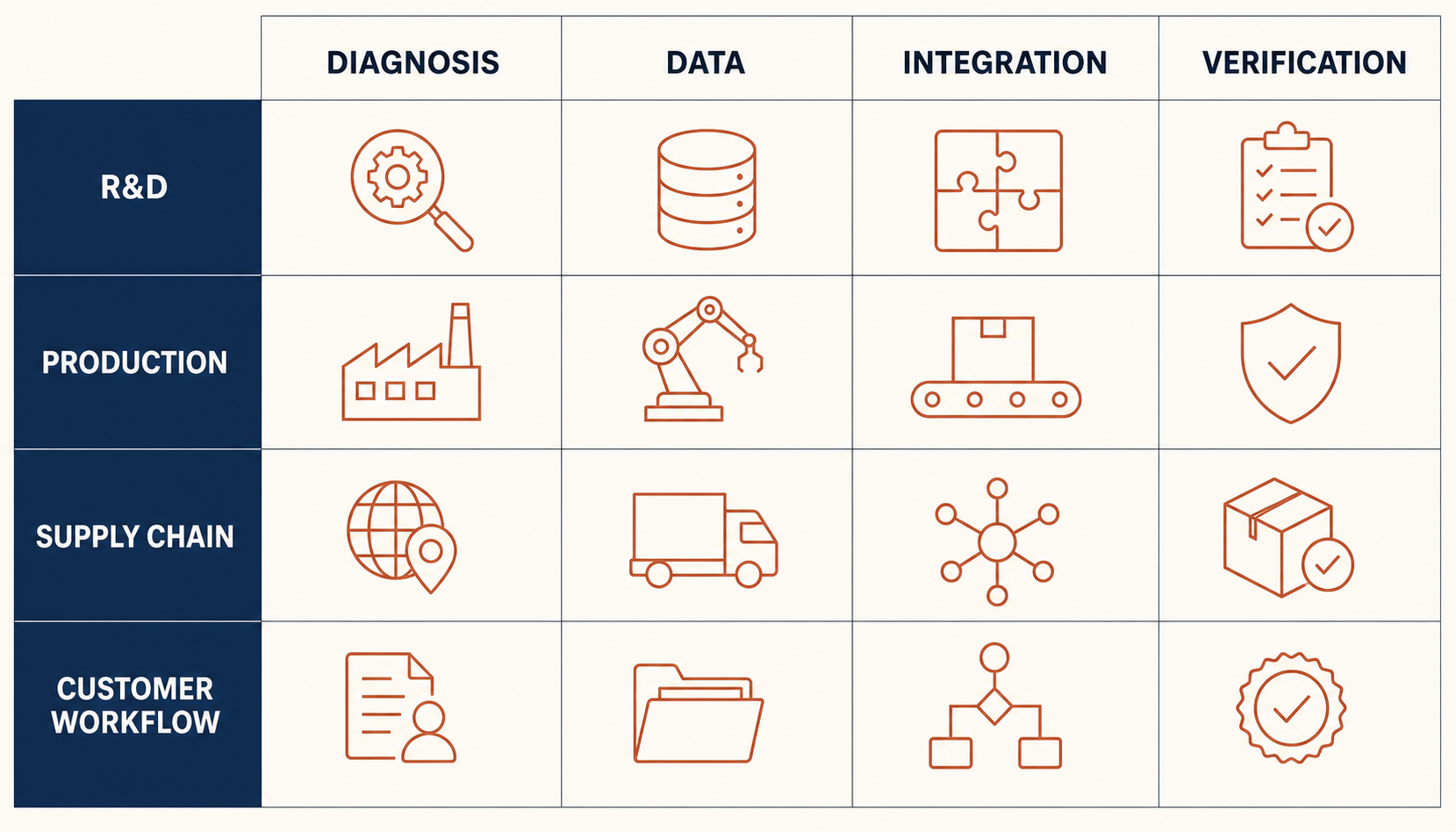
An overseas expert sees a familiar brief: “Help Chinese SMEs adopt AI.” The natural response is a catalogue. Add a prompt course, a workflow workshop, a chatbot module and a few tool demonstrations. The list looks comprehensive, but it has not answered the first operational question: which business work is supposed to change?
China’s 2025 city-pilot notice for small and medium-sized enterprise digital transformation points in a different direction. It asks pilot cities to identify concrete industries, analyse SME transformation needs, and focus on key business links such as research and development, production, products and supply chains. It even names the practical reasons firms may not move: they may not want to, dare to or know how to transform.
That notice is a policy and programme design signal. It is not a ready-made course syllabus or proof that every SME wants an overseas AI workshop. Its useful lesson for an expert product is narrower: begin with a workstream map before selecting tools or lessons.
The decision hidden inside “AI adoption”
“AI adoption” can describe at least four different decisions:
- whether a team can see a repetitive or expensive work step;
- whether the step has usable data and a responsible owner;
- whether a tool can be tested without breaking the process;
- whether a measurable change is worth carrying into routine work.
A course that starts with tool names skips these questions. It may teach a feature correctly and still leave a learner unable to decide where that feature belongs.
The ministry notice does not say that an overseas expert may solve these problems. It does show that a public pilot framework expects cities to work from industry and business links. That is enough to inform the shape of a research brief, not enough to justify a market claim.
Build the map around work, not software
Start with the workstream. In a manufacturing example, it might be production scheduling, quality inspection, supplier coordination or product documentation. In a professional-services firm, it might be proposal preparation, client reporting, research or internal knowledge transfer.
Then ask four questions:
- What action currently takes place, and who owns it?
- What information enters and leaves the action?
- Where does delay, repetition or uncertainty appear?
- What would count as an observable improvement without promising a financial result?
Only after those questions should a tool or course module enter the map. A retrieval exercise may be relevant to document-heavy work. A workflow exercise may be relevant to repeatable handoffs. A model-evaluation exercise may be relevant when a team needs to compare outputs. None is automatically relevant because it is fashionable.
The policy document’s narrow evidence
The 2025 notice is useful because it distinguishes industries, pilot cities, key enterprises and key business links. It encourages cities to identify common transformation needs by sector and to focus on business areas where digital work can be deepened.
What can an expert responsibly take from that?
They can use the document to structure questions for a potential buyer: which industry and business link are in scope, what diagnosis has already been done, what process is being changed, and what verification is expected. They can use it to avoid presenting a generic “AI for everyone” syllabus.
What can they not take from it?
They cannot say SMEs broadly need the expert’s course. They cannot infer that a city pilot will hire a foreign trainer. They cannot infer a budget, procurement route, platform access or implementation result. The notice is not a buyer interview and not a purchase order.
A concrete scene: the tool list that stalled
Imagine an overseas instructor preparing a one-day workshop for a supplier cluster. The draft agenda has six modules: prompting, agents, RAG, automation, image generation and AI video. The organiser asks which module matters most. The instructor cannot answer because no workstream was selected.
Now redraw the first page as a map. The participants document how a production change is requested, approved, communicated to suppliers and recorded. The workshop can then ask whether a retrieval step, a structured form or a review checkpoint might improve one handoff. The instructor still has no proof that the intervention will work. But the learning task is now attached to a visible piece of work.
The distinction is important. The example is a constructed planning scene, not a reported client result. It demonstrates how to use the policy signal without turning it into a success story.
“Won’t” and “can’t” are different learning problems
The notice’s language about firms that do not want to, dare to or know how to transform is useful because it prevents a one-dimensional explanation. A company that does not want to change may need a clearer problem definition or decision owner. A company that does not dare may be worried about disruption, responsibility or unclear evidence. A company that does not know how may need a capability-building path.
These are not interchangeable course audiences. A tool tutorial may help the third group and fail to answer the second group’s risk question. A strategy workshop may help a decision owner and frustrate a team that needs a concrete operating exercise.
The policy text does not tell an expert which group is present in a specific company. It tells them to avoid treating “SME digital transformation” as one learner profile.
The offer should have a stopping point
An expert product can be honest about where it stops. A first engagement might produce a workstream map, a dependency list and one testable learning task. It might not include deployment, data migration, system integration or ongoing support.
That boundary is especially important for an overseas expert. A public policy signal can inspire a useful diagnostic method, but it cannot grant access to a company’s systems or establish the consultant’s qualification to change them.
If the reader only needs general AI literacy, a workstream map may be unnecessary. If the reader has no defined industry, process owner or problem, a tool catalogue may also be premature. The correct next step may be a short discovery exercise rather than a full course.
A counterexample: when a tool-first lesson is reasonable
Tool-first teaching is not always wrong. If the buyer has already selected a workstream, supplied representative materials, defined the user and authorised a bounded experiment, a feature demonstration can be efficient. The workstream map has already done its job; the lesson can focus on execution.
The error is starting with the tool while pretending the workstream has been validated. A feature can be taught as a feature. It should not be labelled a transformation solution without the missing context.
A four-line pre-brief
Before an overseas expert proposes an SME workshop, ask the buyer to complete four lines:
- Industry and business link in scope.
- Current work and responsible role.
- Evidence of the problem or delay.
- Smallest acceptable test and what it will not cover.
If the buyer cannot answer, do not fill the gap with a larger AI catalogue. Keep the offer at discovery or mark the topic as unready.
The sentence worth carrying forward is: a policy signal can shape the questions; only a defined workstream can shape the lesson.
If you are deciding whether an expert product can be narrowed to a concrete China-facing SME workstream, request a China validation review. Bring the process map and the policy source separately.
Related reading
- Product Portability Audit
- When Topic Popularity Is Not Buyer Demand
- Buyer–Problem–Alternative–Delivery Worksheet
- A China Training Procurement Brief Is a Service Scope, Not a Course
Sources and evidence boundary
- 2025 SME digital-transformation city-pilot notice, checked 2026-08-23. Describes policy focus on industries, SME diagnosis and key business links; does not prove general demand, an overseas route or a course purchase.
Image brief: A workshop wall with R&D, production, supply chain and customer-workflow lanes, each marked with diagnosis, data, integration and verification questions. No tool logos, growth charts or claims of universal SME demand. Alt text: “A workstream map connects SME business processes to digital transformation questions before selecting tools.”