
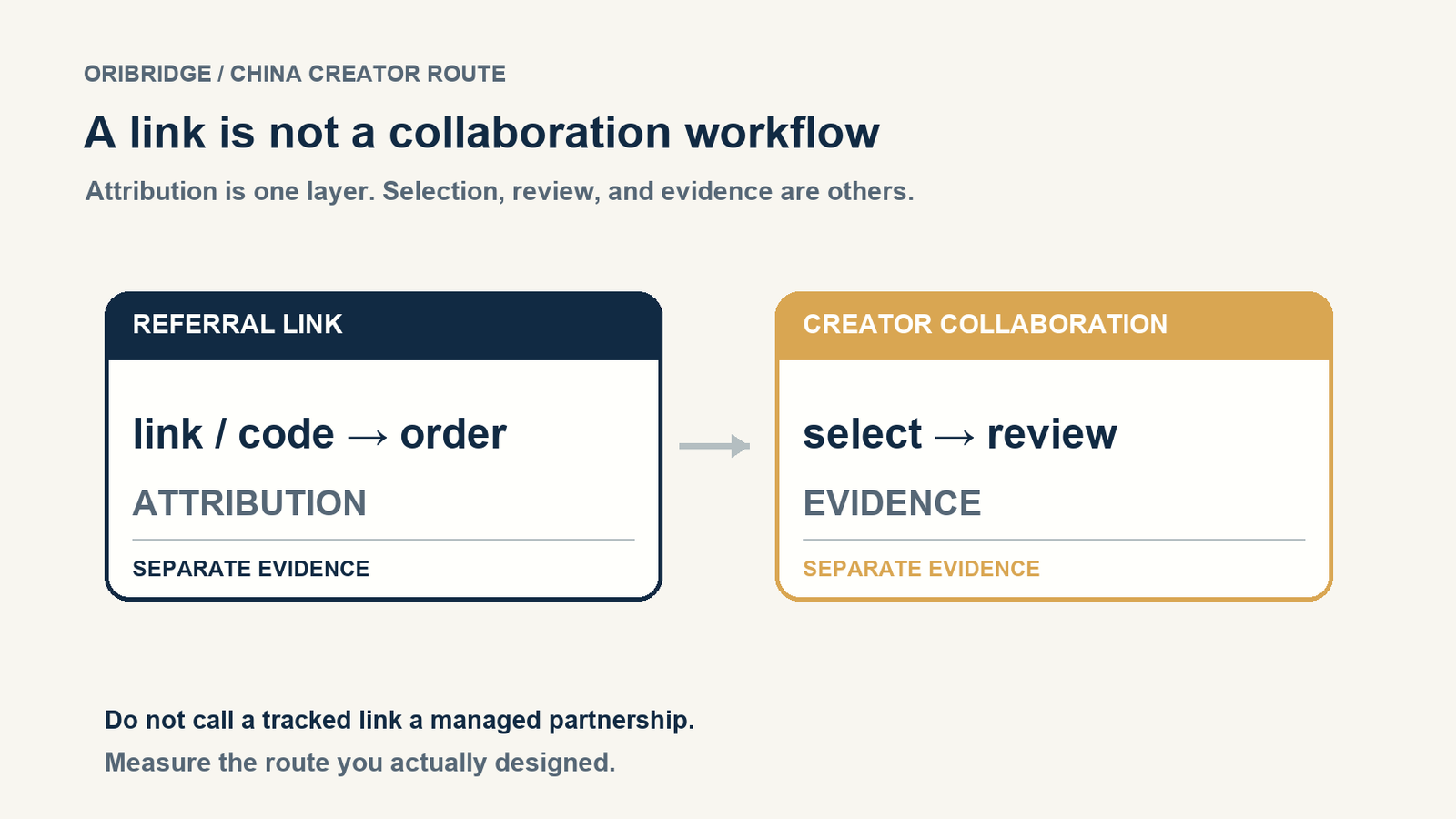
If your China plan starts with “find five creators and give them a link,” pause. A link can track a referral. It cannot select the right collaborator, explain the brief, review the content, or tell you what happened after publication.
That distinction matters when an overseas expert is testing a course, a workshop, or a knowledge product in China. The familiar affiliate model is attractive because it looks small: create a link or code, offer a commission, and watch orders. But a creator collaboration may contain several separate operating jobs before anyone reaches a checkout.
The overseas model: a link is the mechanism, not the whole relationship
Shopify’s official Collabs documentation describes affiliate programs around links or codes, commissions, and order tracking. It distinguishes open programmes from invite-only programmes.1
That is a useful mental model for attribution. You can ask:
- Which creator received which link or code?
- Which order was attributed to that identifier?
- What commission rule applies to that order?
Those questions are important. They are not the same as asking whether the creator understands the product, whether the content is accurate, or whether the collaboration should happen at all.
What the Xiaohongshu surface makes visible
Xiaohongshu’s official Pugongying materials present creator collaboration as more than a tracking link. The official home displays different collaboration directions, including customised work, batch cooperation, testing, live-streaming, and broader campaign services. It also makes stages such as creator selection, invitation, content cooperation, and post-campaign review visible.2
Its help centre separates areas including brand onboarding, creator discovery, cooperation modes, invitation tools, data, content review, and industry qualifications.3
That evidence supports a narrow operational point: on this official collaboration surface, “who to work with,” “how to invite them,” “what content is produced,” and “how the result is reviewed” appear as distinct tasks. It does not tell us that an overseas expert is eligible, that a particular course will be approved, or that any campaign will produce sales.
Two models, two kinds of evidence
| Question | Referral-link experiment | Creator-collaboration route |
|---|---|---|
| Main job | Attribute an action to a creator | Coordinate a collaboration from selection through review |
| First evidence | A link/code, an order event, and a stated commission rule | A selected creator, an accepted brief, an approved content path, and a post-campaign record |
| Useful early question | Did an attributable action occur? | Did the chosen creator and content route make the offer understandable and reviewable? |
| What it cannot prove alone | That the creator is a good fit or the message is accurate | That an overseas entity qualifies, that reach is sufficient, or that sales will follow |
The table is an editorial comparison, not a Xiaohongshu or Shopify template. The exact fields, permissions, commercial terms, and review requirements must be checked for the proposed product and route.
A scene that exposes the difference
Imagine a course creator has a strong English landing page and a discount code. A collaborator posts a Chinese-language note, but the note describes the course as a certification programme. The original offer never promised certification.
The affiliate dashboard may still attribute a click. Attribution does not repair the wrong promise. A managed collaboration process would have created a point at which the brief, claims, audience, and final content could be checked before publication. That check is not a substitute for a link; it is a different control.
The same problem appears in the opposite direction. A creator may be a good editorial fit but have no agreed purchase route. Strong content then creates attention that the team cannot convert or even measure cleanly. A collaboration record should therefore separate content response from purchase evidence instead of calling every reaction a sale signal.
When this comparison does not apply
If you are only testing whether a short explanation is understandable, and no creator is being engaged to publish, promote, or sell it, this article is not a reason to build a collaboration programme. Run a defined content test and label its evidence as content evidence.
If a creator is being asked to recommend a paid product, however, the referral link is only one possible measurement layer. It does not replace creator selection, a clear brief, claims review, permissions, or a post-campaign review.
What to record before calling the test a result
For a proposed China creator collaboration, keep these questions in separate fields:
- Selection: Why this creator for this audience and product question?
- Invitation: What was proposed, and what did the creator accept?
- Content: Which claims, examples, and language were approved before publication?
- Attribution: What action can a link, code, form, or other mechanism actually identify?
- Review: What happened after publication, and which part remains unknown?
This record makes the experiment slower than pasting a link. It also makes the result more useful. You can see whether the problem was creator fit, message clarity, content accuracy, checkout, or simply a missing measurement path.
For the wider channel decision, compare this route with the separate jobs involved in marketing an online course on Douyin, the distinction between a Xiaohongshu professional account, content/live activity, and a store, and the case for choosing a small number of China-facing channels before building everything.
What this article cannot prove
The cited pages do not establish that an overseas person or entity can use Xiaohongshu Pugongying, publish a particular course, pay or receive a particular commission, or run a legally compliant campaign. They do not establish creator reach, audience fit, traffic, conversion, sales, or return on investment. They also do not turn one platform’s visible workflow into a universal rule for every Chinese platform.
If you need to decide whether a specific creator route is testable, request a scoped validation review with the product, intended audience, proposed collaboration, claims, purchase path, and evidence you want to collect.
Sources and limits
-
Shopify Help Center, “Collabs programs”, checked 2026-08-16. Used only as an overseas reference for open/invite affiliate programmes, links/codes, commissions, and order tracking; not as evidence of Chinese platform rules. ↩
-
Xiaohongshu Pugongying, official home, checked 2026-08-16. Used only for the visible categories and work-stage descriptions on the official collaboration surface; not used as evidence of eligibility, fees, traffic, or outcomes. ↩
-
Xiaohongshu Pugongying, official help centre, checked 2026-08-16. Used only for the help-centre topic separation; not used as a specific course approval, advertising-law, contract, or tax conclusion. ↩