
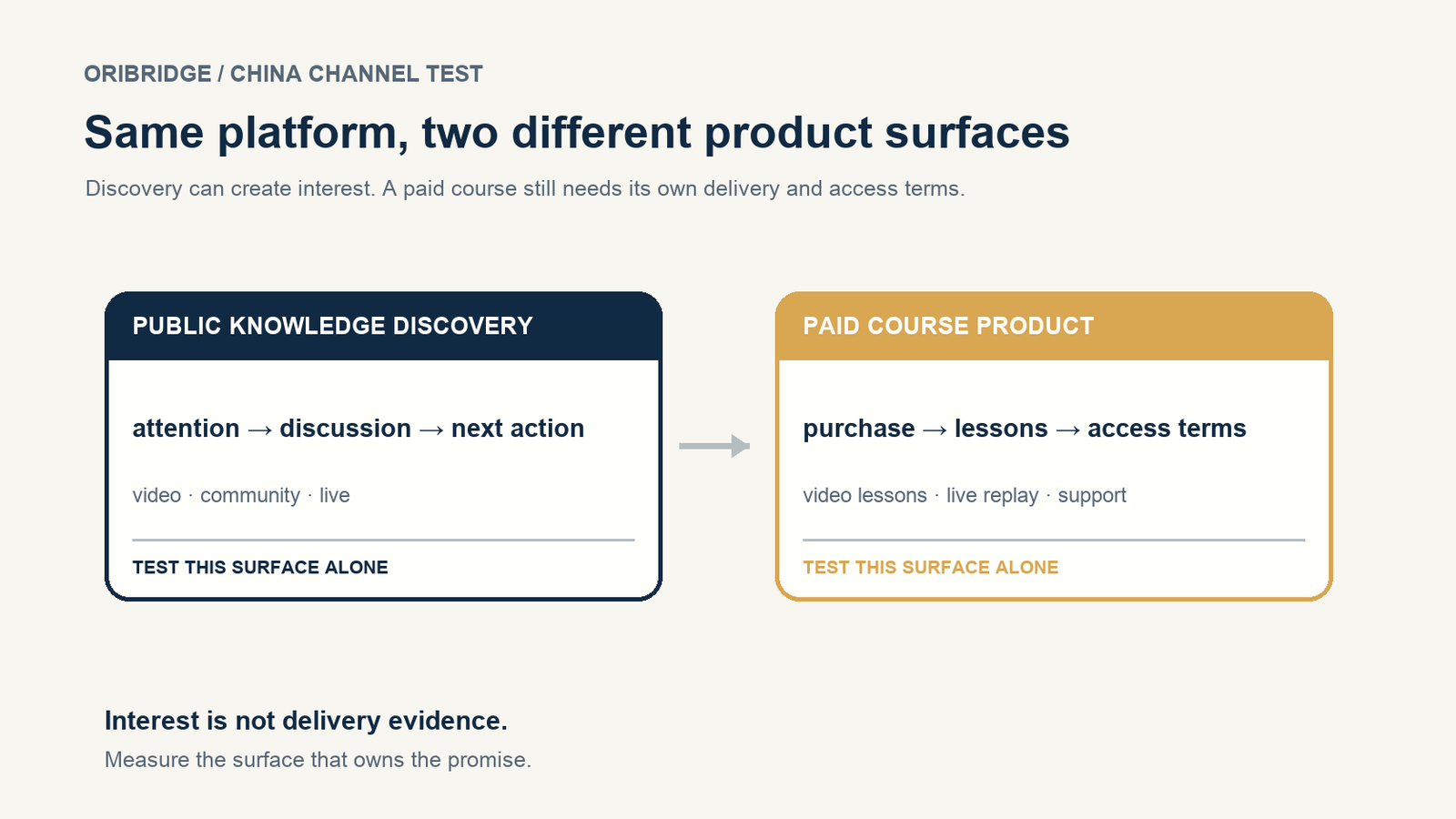
An expert finds thoughtful videos and active comment threads on Bilibili, sees a course-related surface, and concludes that a paid learning product has found its China route. The conclusion is tempting because each part is real. It is also too fast.
A knowledge audience, a public discovery surface, and a paid-course route are three different products to design and verify. A person who watches a serious video may not be the buyer. A buyer may not have access to a checkout route. A paid route may still lack a support, learning, refund, or content-rights plan.
This article is not a claim about platform eligibility, commercial terms, payment availability, or course demand. It is a decision tool for avoiding a common category error: treating visible interest as a complete delivery system.
The same separation matters on other platforms. The Xiaohongshu account-and-store guide shows why identity, content discovery and transaction surfaces should not be collapsed into one claim.
First, name the three separate questions
It helps to put the questions on three cards rather than in one large sentence.
| Card | The real question | A useful observation | What it does not prove |
|---|---|---|---|
| Audience | Who recognises the topic? | Viewers comment on a relevant problem | They will buy a course |
| Offer | What is being sold? | A learning product can be described clearly | It has a viable commercial route |
| Delivery | Can the promise be carried? | A route may have visible course surfaces | Access, payment, support, rights, or outcomes |
The cards should not be collapsed. If a team receives audience interest but cannot state what buyers receive and how support works, it has a discovery signal, not a course launch. If a team has a course page but no evidence that the intended buyer recognises the problem, it has an offer object, not validated demand.
What the public Bilibili surfaces can and cannot say
Bilibili’s public course cooperation help page and its course-search surface show that course-related materials and discovery paths exist on the platform. This can support a limited research step: map the visible object, its labels, and the questions a potential contributor would need answered.
It cannot support stronger claims without route-specific evidence. A public help page does not establish that an overseas expert is eligible to cooperate, that a particular content type is accepted, that any payment route is available, that learner support is provided, or that a knowledge audience will purchase a course. Those must be verified for the precise entity, asset, and proposed offer before operational work begins.
This restraint is useful because platform pages can feel like proof. They are usually proof of a surface, not proof of your route through it.
The misleading shortcut: “the audience is already there”
Consider an expert in visual storytelling. Their public video about a difficult creative decision attracts thoughtful questions. That may indicate that the topic can be made legible to an interested viewer.
It does not tell the expert whether a paid offer should be a self-paced course, a cohort, a workshop, or a diagnostic. It does not tell them whether the audience wants practice, feedback, a certificate, a community, or only free explanation. It also does not establish whether the expert has the rights and operations in place to deliver a localised version.
The responsible next question is not “How do we upload the whole course?” It is “Which decision does this audience signal allow us to test next?”
Build the offer before chasing the route
An offer needs a buyer, an outcome, a delivery form, a support boundary, and a way to know whether it helped. A route needs access, payment, delivery, support, and an owner for each handoff. Neither can be inferred from a good video.
For example, a short video may help an expert test whether a common problem is recognisable. A small workshop may test whether a group will complete one specific task. A self-paced course may be appropriate only once the learning outcome, asset rights, support load, and delivery conditions are clear. They are different tests, not phases that automatically follow one another.
The format comparison in self-paced course, cohort, workshop, and advisory is useful here because it separates what is being delivered from how it is discovered. The end-to-end access, payment, and delivery test script is a different check: it records whether a proposed route can carry an actual learner through the required handoffs. And the China channel map keeps platform choice from becoming a substitute for buyer evidence.
The counterexample: when an audience signal is enough
Sometimes a public audience signal is exactly what the team needs. If the only current decision is whether a problem statement resonates, a cluster of informed questions or responses can be a useful early indicator. It may justify refining a content brief or conducting a small number of buyer conversations.
It is not enough when the decision is commercial or operational: whether to promise a learning outcome, accept payment, open access, provide customer support, or grant content-use rights. Those decisions require a different class of evidence.
A practical evidence notebook
Keep these observations separate:
- Audience language: how people describe the problem in their own words.
- Offer hypothesis: what bounded result the expert proposes to help with.
- Route checks: who can access, pay, receive, ask for help, and exit fairly.
- Rights record: what the expert has actually authorised to be adapted, shown, or delivered.
- Decision record: what evidence would make the team revise or stop.
The notebook prevents a common retrospective error. Months later, a team can otherwise look at a successful public post and remember it as proof that the commercial route was ready. It was not. It was proof only of what the post actually revealed.
A constructed record could read: audience wording: “I can follow the explanation, but where would I practise this?” offer hypothesis: a reviewed practice session may be more useful than a video library. route unknown: no verified access, payment, support, or refund path. rights boundary: public clips may be analysed; no course adaptation or sales use is authorised. next decision: ask whether the intended learner values feedback enough to test a bounded workshop. None of those fields is Bilibili user data or a reported test result.
Keep the date and evidence owner beside each field so later teams do not promote an old observation into a current platform or demand claim.
Why this distinction protects the expert
For an overseas expert, the risk is not only wasted effort. If a public audience signal gets treated as permission to upload, sell, or adapt course material, the team can cross an authorisation boundary before it has even tested the buyer question. Rights to display a clip, translate a lesson, package a paid course, distribute it, or use an expert’s name in a promotion are not interchangeable.
Keeping audience, offer, delivery, and rights as separate records slows the first meeting down slightly. It also prevents a later argument over what somebody thought had been approved. A careful route does not ask the expert to grant broad permissions in order to learn whether the original problem is recognisable.
The best next action
If you see relevant Bilibili audience activity, do not rush to call it a course opportunity. First choose which of the three cards is unresolved. If it is the audience card, collect language and test the problem statement. If it is the offer card, design one honest, bounded outcome. If it is the delivery card, run a route-specific access, payment, and support check before making promises.
That is slower than equating an audience with a market. It is also much less likely to create a course page that nobody can confidently buy, receive, or use.
The approach has a practical benefit: it keeps an early research result usable even when the broader commercial route is not ready. A team can learn from public audience language without misleading viewers, binding itself to untested delivery work, or treating a platform surface as a partnership. That is a better foundation for a later decision than a page that confuses attention with readiness.
If the next decision needs an independent buyer, offer, and route review, send OriBridge the public product link and the proposed test.
Sources and boundaries
- Bilibili course cooperation help, checked 2026-08-24 — supports only the visible cooperation-help surface.
- Bilibili course search, checked 2026-08-24 — supports only the visible course-search surface.
- These public pages do not prove contributor eligibility, terms, payment availability, demand, learner outcomes, or any right to use an expert’s materials.