
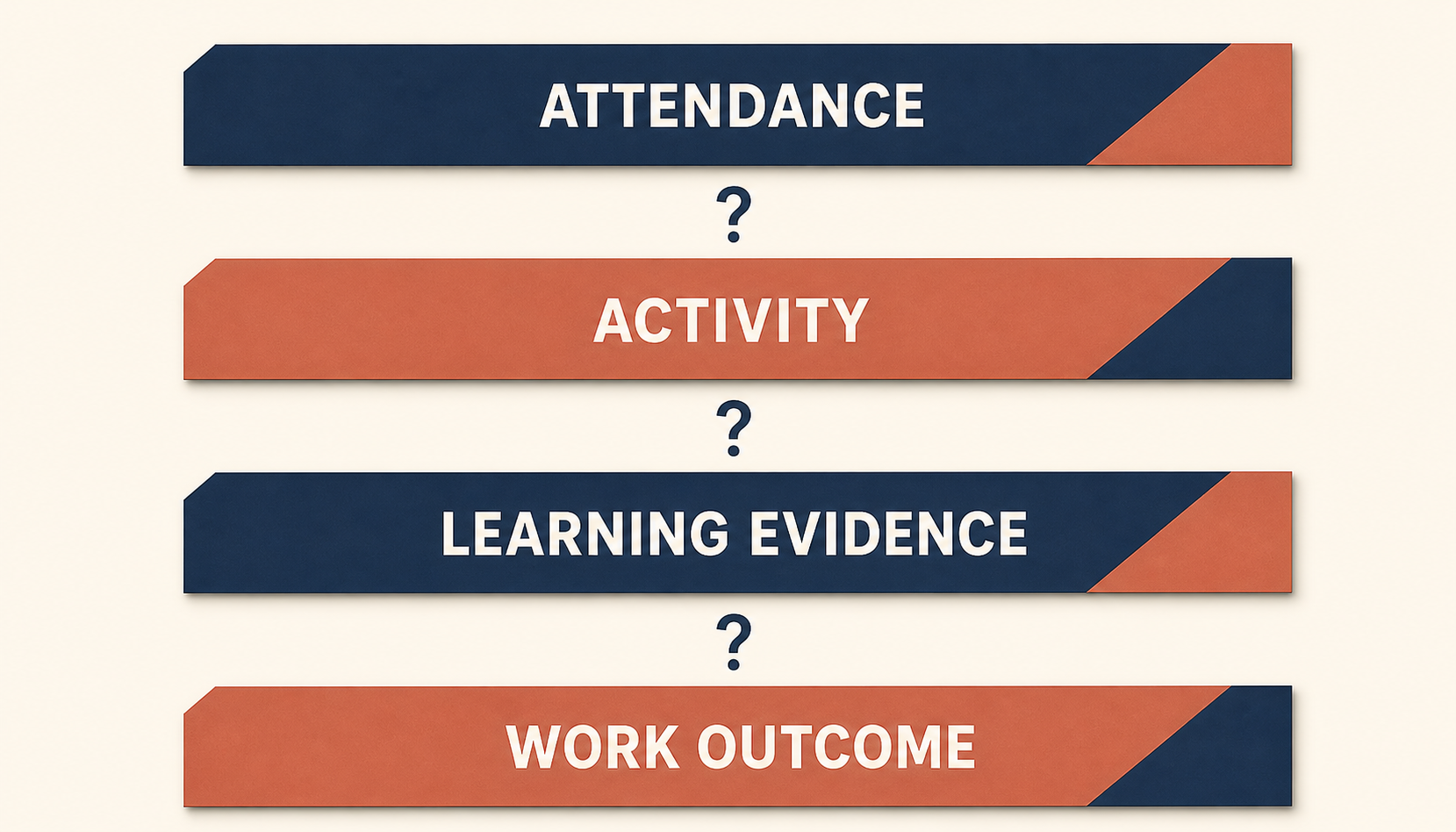
“Forty learners completed the course” is a tidy sentence. It may also be the wrong sentence. A platform completion marker normally says that a defined activity, unit or sequence reached its recorded end state. It does not automatically say that a learner understood the material, changed a behaviour, solved a work problem or created commercial value.
For a China-facing programme, the fix is not to discard completion data. The fix is to name the layer being reported. Completion can be a useful operational measure when it stays a completion measure.
Four levels that should not be merged
Participation covers attendance, access and presence. Activity completion covers watching, clicking, submitting or reaching a platform-defined end state. Capability evidence covers a demonstrated task against a stated rubric. Business outcome covers an agreed operational or commercial change measured over a suitable period.
ClassIn 5.0 presents activities, learning progress and capability indicators as distinguishable product concepts. That does not prove the platform has measured a particular learner’s capability; it shows why an operator should avoid using “complete” as a universal synonym. Tencent Meeting’s participant and check-in surfaces are even narrower: they can help document presence, not mastery.
Reporting language that survives review
Use verbs that match the evidence:
- “38 accounts reached the final video marker.”
- “31 submissions were recorded against the exercise.”
- “A reviewer scored 12 submitted examples against the agreed rubric.”
- “The buyer’s follow-up review is scheduled for 30 days after delivery.”
Avoid the unqualified leap: “38 employees are now able to standardise an AI workflow.” That would require a capability definition, evidence and a measurement method. If the buyer’s only agreed KPI is video completion, report that KPI and label it as such.
Illustrative scenario
An overseas expert supplies six short modules for a China-facing internal pilot. Forty employees reach the final module. Twelve submit a workflow example. A reviewer finds that seven examples meet the rubric, three need revision and two are incomplete. The responsible report has several lines:
| Layer | Observed marker | What it says |
|---|---|---|
| Access | 40 reached the final module | platform progress was recorded |
| Practice | 12 examples submitted | a task was attempted |
| Capability | 7 met the rubric | seven reviewed examples met defined criteria |
| Outcome | not yet measured | follow-up evidence is pending |
This may feel less impressive than a certificate count. It is more useful to a buyer deciding what to improve. It also avoids claiming that seven individuals changed their work behaviour simply because seven submissions met a task rubric.
The counterexample: when completion is the outcome
Completion can be the outcome if the scope explicitly defines it that way. A compliance briefing may require every invited employee to view a prescribed module and acknowledge a policy. The report can truthfully state completion against that narrow requirement, provided the system and identity rules are clear.
Even there, do not smuggle in extra claims. Completion of an acknowledgement is not proof of future conduct, comprehension or absence of risk. The measurement is valid because the commitment is narrow, not because completion has magical explanatory power.
Why certificates do not solve the problem
A badge or certificate is another marker. Its meaning depends on issuer, criteria, identity checks and the promise made to the recipient. A platform page describing progress or a certificate feature cannot establish that a certificate is professionally valid, accepted by a buyer or evidence of competence. Keep certificate issuance in the process layer unless a separate standard defines what it means.
The same caution applies to “engagement.” Clicks, attendance and submissions can reveal where an operational process reached a state. They can be useful clues for a follow-up review. They do not by themselves explain why a learner acted, whether the content was understood or whether a business result followed.
What the sources cannot prove
The ClassIn pages support the existence of course, activity, progress, capability-indicator, classroom and reporting surfaces. Tencent Meeting supports participant and check-in management. None of those product pages proves a course’s quality, learner improvement, ROI, buyer satisfaction, certificate validity, procurement acceptance or repeat demand. Those claims need separate evidence and an agreed method.
For a delivery-field view, read Buyer–Problem–Alternative–Delivery Worksheet. For an enterprise purchasing frame, see China Training Procurement Brief: Service, Not Course. For AI workshop practice and evaluation boundaries, see AI Agent Workshop: China Workflow Evaluation.
A reporting template
Put the following labels in the report:
- Marker: what the platform or reviewer recorded.
- Population: who or what was counted, and how identity was represented.
- Rule: the definition of complete.
- Evidence: export, submission, rubric or follow-up measurement.
- Unknown: the claim the current record cannot support.
This format works for a small pilot or a larger programme. It forces the writer to state whether the result is a process marker or an outcome measure. “Unknown” is not a failed report; it is a useful handoff to the next measurement step.
If you need help defining a narrow, evidence-backed validation question for a China-facing training asset, submit a validation request. It does not promise a learning outcome, buyer acceptance or ROI.
Sources and evidence boundary
- ClassIn 5.0 — checked 2026-08-23. Supports separate activity, progress and capability-indicator surfaces; does not prove capability change.
- ClassIn LTI — checked 2026-08-23. Supports classroom data and reporting surfaces; does not prove course success.
- Tencent Meeting Personal Center — checked 2026-08-23. Supports participant/check-in management; does not prove identity, learning or outcomes.
Designing the next measurement
If completion is not enough for the decision you need to make, define the next layer instead of criticising the existing metric. Write the target behaviour in observable terms, choose an exercise that can reveal it, and state who will review the evidence. Decide whether the review is formative, an acceptance check, or a later business measurement. These purposes should not share one undifferentiated score.
For example, a workshop may define “produce a source-linked draft workflow” as the practice task. The operator can record whether a submission exists, whether required fields are present, and whether a reviewer marks it against the rubric. A later follow-up may ask whether the workflow was used in a real team process. The first three records are available at delivery; the last one is a separate observation window.
Do not make the rubric more precise than the promise. If the programme is exploratory, write “illustrative review rubric” and keep the result provisional. If a buyer has accepted a fixed rubric, preserve its version and reviewer identity. Either way, a completion marker remains useful as a map of process progress. It simply does not carry the burden of proving every downstream result.
This layered approach also helps localization. A translated module may be completed while an example, term or task remains unclear to a Chinese audience. Completion can flag that the file was consumed; a localized rubric and reviewer notes can reveal whether the material travelled. Neither should be treated as a proxy for revenue or broad product-market fit.
When exporting a report, put the definition beside the number. “Completion = final page marker” is much safer than a column headed “trained.” Keep the denominator visible as well: invited accounts, started accounts and eligible submissions may be different populations. If a learner opts out of a task, that is a missing observation, not evidence of failure. A reviewer can then decide whether the next pilot should change the task, the support route or the measurement window.
The wording also matters when a report is translated. Terms such as “completed,” “qualified,” “certified” and “effective” can carry different expectations for a Chinese buyer. Keep the original operational definition and add a short explanation of the evidence. Do not upgrade a convenient English label during localization. A bilingual glossary can help, but it cannot create an outcome that the underlying record does not contain.
Ask the report reader what decision the metric is meant to support. If the decision is whether to send a reminder, completion may be enough. If it is whether to revise a lesson, submissions and reviewer notes are more useful. If it is whether to expand a programme, a later outcome study is required. One number should not be forced to answer all three questions.
Measurement becomes more honest when the decision and the evidence are written together.
That discipline is especially important when a translated report will be reused by another team.
The definition should travel with the number.
That small habit prevents later readers from importing a stronger meaning than the original evidence supports.