
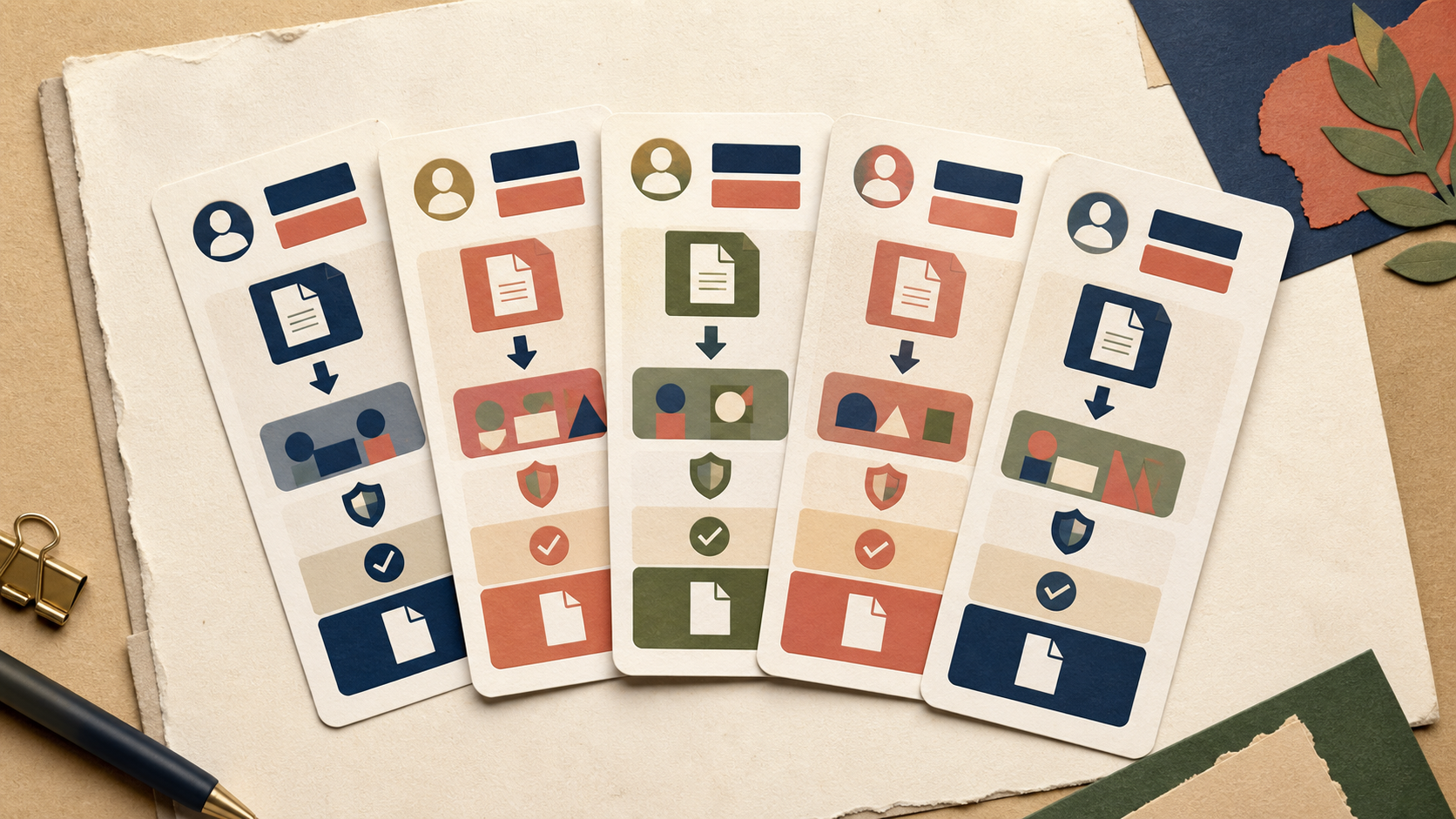
Translation answers a language question. Learning design answers a different question: what is the learner supposed to do, with what material, under what constraint, and how will anyone know whether the attempt makes sense?
An AI course can have accurate Chinese subtitles and still leave a China-facing learner stranded. The demonstration may assume a familiar role, a source package, a tool dependency or an approval step that never becomes visible in the translated lesson.
Build a bilingual scenario bank before localization. It is a set of small, editable cards—not polished case studies—that give every important exercise a role, starting material, task, constraint, review point and output. The same card can then be used to review video, subtitles, worksheets and FAQs.
The anatomy of a useful card
| Field | What it prevents |
|---|---|
| Role | an exercise for an imaginary “user” |
| Starting material | invented evidence or unexplained inputs |
| Task | a passive demo mistaken for practice |
| Tool / dependency | a hidden assumption about access |
| Judgment point | a click sequence mistaken for skill |
| Common failure | vague feedback after the fact |
| Reviewable output | a claim of completion with nothing to inspect |
| Localization notes | last-minute terminology changes |
A constructed card
Role: an operations manager preparing a comparison for an internal meeting.
Starting material: three public product pages supplied in the lesson pack.
Task: create a bilingual table that separates a quoted source fact, an observation and an unresolved question.
Constraint: do not add facts that are absent from the source material; mark uncertainty rather than filling a gap with an AI answer.
Reviewable output: a table with links or citations to its three starting pages.
The card is not a promise that a particular Chinese AI tool is accessible, reliable or suited to the task. It is a teaching object. It lets an editor ask whether the translated instructions, screenshots and terms still support the same learner decision.
Why a scenario bank beats a rewrite sprint
Without cards, teams often localize in the order that files arrive: subtitles first, then slides, then a worksheet if time remains. A scenario bank reverses the order. It identifies the few situations a learner must genuinely navigate, then checks every asset against those situations.
That is different from an AI-agent workshop evaluation. A workshop tests a method in a bounded setting. The scenario bank is the reusable cross-module asset that keeps one method legible across formats.
It is also different from localizing an expert product beyond translation. A localization plan can describe a curriculum. A card exposes whether a learner has enough material and decision criteria to act.
Make cards small enough to use
Start with three cards from the first module. Do not write heroic, highly detailed personas. Pick situations that force a real choice: compare sources without inventing evidence; decide whether an output is ready to share; identify the tool or terminology dependency that must be explained.
Bring the cards into a subtitle review. If a translated term changes the task, record it. Bring them into an exercise review. If the learner now needs a different input, update the card. Bring them into the FAQ. If a common question appears, determine whether the scenario is underspecified rather than automatically adding support copy.
The course dependency and terminology inventory can provide the technical and language inputs; the scenario bank turns them into a learning situation.
Review one card across four assets
Once a card exists, use it as an editorial test. Start with the video. Does the demonstration reveal the role, starting material and expected output, or does it assume them? Then open the subtitle or transcript. Does a translated term change the constraint—for example, turning “cite the source” into a vague instruction to “refer to information”?
Next inspect the worksheet. Can a learner work from the supplied input without guessing what counts as evidence? Finally inspect the FAQ or support copy. If the same question appears repeatedly, it may indicate that the scenario card lacks a condition, not that the support team needs a longer canned answer.
| Asset under review | Card field to check | Common repair |
|---|---|---|
| Video | role and starting material | add a one-sentence setup before the demonstration |
| Subtitle / transcript | constraint and terminology | revise the defined term, not every sentence |
| Worksheet | task and reviewable output | add the source fields and output example |
| FAQ | common failure | clarify the exercise boundary or prerequisite |
The goal is continuity of the learning decision, not literal equivalence of every screen.
Choose scenarios by pressure, not by chapter order
Teams frequently build scenarios in the order a course is filmed. That can be convenient and wrong. Start with moments where a learner must make a consequential judgment: distinguish a fact from an inference; decide whether an output can be shared; identify a missing input; or explain why a tool result is not enough to support a claim.
These moments are more reusable than a tutorial on a particular interface. They also survive better when an AI tool changes. Official materials may describe distinct subtitle, retrieval, knowledge-base or function components, but they do not guarantee that an account, region or learner has access to each component. A scenario that teaches evidence handling can remain useful even when an interface example needs review.
A three-card starter set
For a first module, create only three cards: one for preparing inputs, one for producing an output, and one for reviewing uncertainty. Give each a different role. For example, an operations manager may assemble sources; a team lead may evaluate a table; a facilitator may decide whether a learner output is sufficiently traceable. Do not invent elaborate company histories. The roles exist to make the required judgment visible.
At the next editorial review, mark each field as confirmed, needs local adaptation, or intentionally unchanged. This creates a durable trail without claiming that the course has been fully localized or validated.
A counterexample: material that is meant to inspire
Not every course asset needs an output. A short opening story may orient a learner or establish a topic. It should be reviewed for meaning and language, but forcing it into a task card would confuse its purpose. The scenario bank is for practice-bearing material.
It cannot prove that people want the course, that a tool is available or accurate, that a translation has rights clearance, or that the exercise improves commercial results. It is a way to avoid a more mundane but expensive mistake: translating a compelling explanation without giving the learner a usable situation in which to apply it.
Preserve the card with the course version
When a scenario changes, save the previous card with the corresponding course version and note the reason: terminology correction, new source constraint, revised output, or removed dependency. This is not bureaucratic overhead. It lets a reviewer see whether a subtitle edit changed the learning task, or only its wording.
The scenario bank should remain small enough to read. If it grows into a catalogue of every possible buyer persona, it has stopped helping editors make decisions. Keep cards only for the situations the course actually asks a learner to navigate.
Hand the cards to a fresh reviewer
Before a larger translation pass, give one card and its linked exercise to a reviewer who did not write the original lesson. Ask them to explain the role, locate the starting material, state the constraint and describe what would count as a reviewable output. Where they have to guess, mark the relevant asset for revision. This is a comprehension check, not a learner-outcome study, but it is a fast way to discover whether an apparently clear course depends on invisible context.
Repeat the check after an important terminology or workflow change. If the task still makes sense with the same card, the update may be local. If the card’s role, source, constraint or output changes, the course has changed more substantially and its public description may need review as well.
When a scenario card is the wrong tool
A founder story, a brand manifesto or a short announcement does not ask a learner to complete an action. Do not force it into a scenario card. Use this method where the learner must judge, produce or revise something.
The bank cannot prove demand, authorization, tool availability, model accuracy or commercial results. It can prevent a more basic failure: translating the words of a lesson while leaving the learner without a situation they can recognize and practise.
Use the bank with an AI-agent workshop evaluation, the guide to what must change beyond translation, and a course dependency and terminology inventory. These checks keep scenario, method and delivery dependencies separate.
Request a China localization review to identify the first three learning situations worth testing before translating the full course.